PromoteTools


Replicate
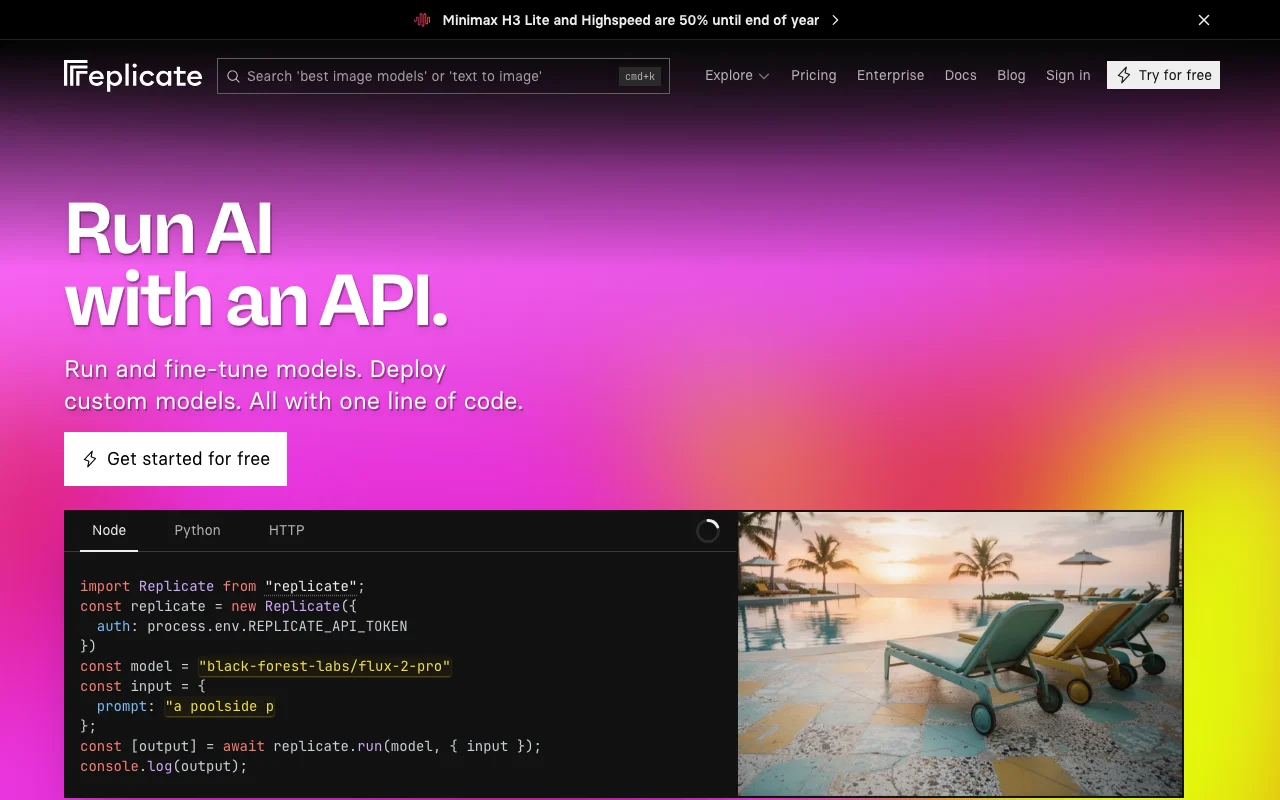
Turn AI workloads into results without managing machine learning infrastructure. Replicate runs open-source models through a cloud API, including image, speech, music, and video generation. It also supports fine-tuning with your training data and deploying custom models via Cog. Use it to run models through code or automate workflows.
#67in Popular, all time
0 points all time
See the full rankingScreenshots
1–2 of 21 of 2
About Replicate
Turn AI workloads into results without managing machine learning infrastructure. Replicate runs open-source models through a cloud API, including image, speech, music, and video generation. It also supports fine-tuning with your training data and deploying custom models via Cog. Use it to run models through code or automate workflows.
What a session in Replicate looks like
It starts by defining the model’s environment in a cog.yaml file, then adding a predict.py file with a Predictor class for the custom model.
From there, you deploy and run the model using the Replicate cloud API.
Replicate pricing
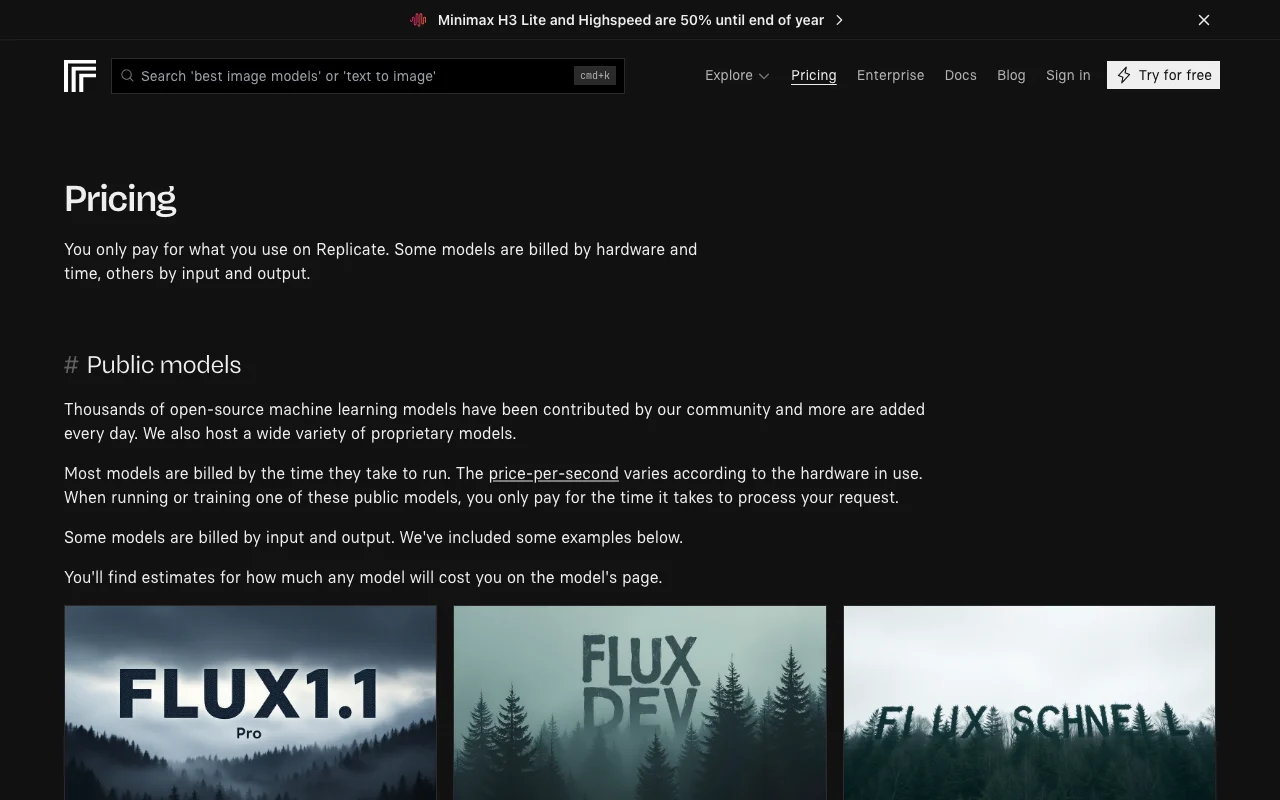
Public models are billed for run time based on the selected hardware. For private models, Replicate bills idle time when instances are online, except for fast booting fine-tunes.
CPU automatic scale is $0.000100 per second and $0.09 per hour. GPUs are priced per second and per hour, including Nvidia T4 ($0.000225 per second, $0.81 per hour), Nvidia L40S ($0.000975 per second, $3.51 per hour), and Nvidia A100 (80GB) ($0.001400 per second, $5.04 per hour). Some public models are also billed by input and output with cost estimates shown on model pages.
Questions about Replicate
Which devices does Replicate run on?
Replicate provides Node.js, Python, and HTTP client options for running models.
Can developers build on Replicate?
Developers can create a Replicate client using a REPLICATE_API_TOKEN and call replicate.run().
Where does Replicate reach its limits?
For private models, Replicate bills idle time when instances are online, except for fast booting fine-tunes.
Similar tools

C3 AI
Agentic operating system for enterprise AI
CodeSandbox
Spin isolated sandboxes to run code safely
DeepL
Translate text, files, images, speech
GitHub
Start free, ship faster with GitHub
OpenRouter
Route requests to the best available modelRanked near Replicate

65. Quillbot
Free paraphrasing and grammar fixes for writers
66. Rask AI
Get localized videos with dubbed audio and subtitles67. Replicate
Run open-source AI models via cloud API
68. Resume Worded
Get a higher score and clearer ATS fit